
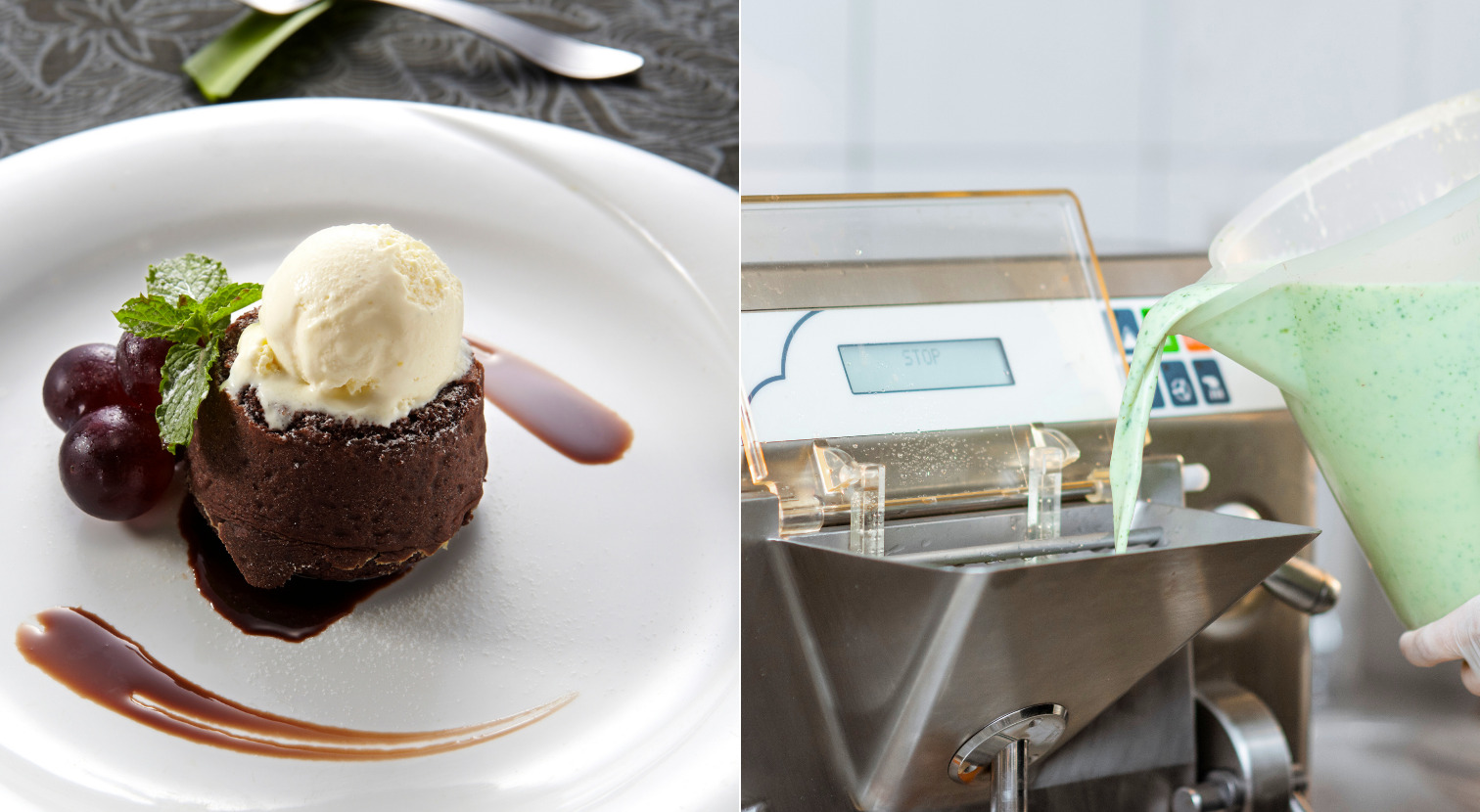
An ice cream chef is first and foremost a creator. They transform delicate raw ingredients such as milk, cream, sugars, natural stabilisers, fresh fruit and chocolate into perfectly balanced ice cream, sorbets and frozen desserts. A successful ice cream is no accident: It is based on a detailed understanding of the physical and chemical properties of the ingredients. Sweetening power (SP) influences texture, fat adds creaminess, and the water content in fruit affects crystallisation. Each parameter has an impact on the final structure.
This scientific dimension requires constant precision. Weighing is done to the nearest gram, maturation and churning temperatures are carefully controlled, and resting times are strictly adhered to. But reducing the craft of an ice cream chef to a technical equation would be an oversimplification. Creativity is the other pillar. Revisiting a vanilla flavour, enhancing a single origin chocolate, creating an herb sorbet or a daring combination requires a true appreciation of taste.
The artisan ice cream chef therefore works in a constant balance between rigour and imagination. They must:
Le travail d’un styliste culinaire s’apparente à un projet d’orfèvre, exigeant autant de rigueur que de créativité. Chaque mission se déploie en plusieurs étapes clés :
The ice cream chef profession offers great freedom in terms of career path. Some choose to work independently, while others prefer to join the teams of renowned establishments. There are two main paths.
Entrepreneurship
Career in a brigade
Mastering the world of ice cream cannot be improvised. The technical discipline required by this profession makes training essential, whether through a CAP (vocational training certificate), a BTM (technical vocational diploma) or specialised programmes dedicated to excellence.
Structured training provides a solid foundation of knowledge that can be applied immediately:
In Paris, learning is based on an immersive teaching method that combines demonstrations by Chefs and intensive individual practice. Each technique is first explained and analysed in detail, then immediately applied in a practical room under the watchful eye of professionals from the most prestigious establishments.
Students develop their skills in a setting that closely resembles the professional world, with high standards and constant attention to precision and creativity.
“I was drawn to Le Cordon Bleu Paris institute because of its reputation, location and the thorough grounding in wine the course provided. Today, I have set up a company called Thomson & Scott and have started working on the production of Skinny Champagne. My wines are sold worldwide and have made headlines across the UK." Testimonial from Amanda Thomson, Alumna - Art, Science and Wine Management Diploma.
This direct transfer of expertise, combined with the institution's global reputation, explains why its graduates are sought after in kitchens and laboratories around the world.Entering the world of ice cream also means mastering a strict regulatory framework. The quality of an ice cream product depends as much on technique as it does on compliance with health standards.
The implementation of an HACCP plan is essential to guarantee food safety, from the selection of raw materials to the storage of finished products. In addition, there are mandatory administrative requirements.
In France, any laboratory or shop opening requires a declaration to the DDPP (Departmental Directorate for Population Protection), which oversees health inspections. Traceability of ingredients, cold chain management, cleaning protocols: Every detail counts.
Serious vocational training programmes incorporate these realities from the outset, in order to prepare future artisans to combine creativity, compliance and operational excellence.Le styliste culinaire est à la fois artisan, artiste et technicien. Pour exceller, il doit développer un large éventail de compétences.
Les compétences techniques
Les qualités personnelles
Il n’existe pas de diplôme d’État unique pour devenir styliste culinaire. Pourtant, une chose est certaine : sans une formation culinaire d’excellence, il est difficile d’accéder à ce métier.
Les programmes en cuisine et pâtisserie de l’institut Le Cordon Bleu constituent le socle idéal. Ils permettent d’acquérir une compréhension fine des produits et des techniques culinaires, indispensable pour manipuler les aliments à des fins visuelles.
À ce socle, s’ajoutent des formations complémentaires en photographie, design ou arts visuels. Les workshops spécialisés en stylisme culinaire sont également une excellente manière de développer un savoir-faire ciblé.Le métier de styliste culinaire offre de nombreuses opportunités et une grande liberté de carrière.
Débouchés
La majorité exerce en freelance, mais il existe aussi des postes en agences de communication, au sein de grandes maisons d’édition ou directement chez les marques alimentaires et gastronomiques.
Secteurs d’activité
Le champ d’action est vaste : presse et édition (livres de cuisine, magazines), publicité (packaging, affiches, campagnes digitales), audiovisuel (émissions TV, cinéma, publicités), sans oublier les contenus pour réseaux sociaux.
Rémunération
Le salaire dépend fortement de l’expérience et de la notoriété. En freelance, les tarifs se fixent généralement à la journée, avec une grande variabilité selon le client et le type de projet. Un styliste reconnu peut atteindre des rémunérations très attractives.
Évolution
Avec le temps, certains stylistes se spécialisent, d’autres deviennent directeurs artistiques culinaires ou consultants auprès de marques prestigieuses. Ce métier offre une évolution continue, portée par la passion, la réputation et l’innovation.
Devenir styliste culinaire, c’est embrasser un métier d’exception où se mêlent cuisine, design et direction artistique. C’est faire le choix de transformer chaque plat en une œuvre visuelle, capable de séduire et de raconter une histoire.
Dans un monde où l’image gouverne les choix du consommateur, ce rôle est devenu incontournable. Avec une formation culinaire proposée par Le Cordon Bleu, une passion créative et une expérience patiemment construite, il est possible de s’imposer dans ce domaine fascinant.
Le styliste culinaire ne se contente pas de dresser une assiette. Il imagine, compose et sublime le produit, révélant l’essence même de la gastronomie contemporaine : une expérience où l’œil précède le goût, et où chaque image devient une promesse de plaisir.
Copyright © 2026 Le Cordon Bleu International B.V. All Rights Reserved.