
Bakers, creative artisans who are devoted to their trade, make a point of sharing their know-how. Artistically and aesthetically skilled, they make a large quantity of breads and freshly baked pastries on a daily basis, providing the quality that demanding customers seek.
Discover how to become a baker and master this culinary art like no other.
After learning the basics of the trade at the institute, students usually start as apprentices or trainees and then carry out various tasks in a pastry shop to reach managerial positions such as chef de partie and then chef boulanger, or they can open a shop or an independent retail business.
A professional boulangerie chef trained in bread baking, who has gained enough experience, can also set up their own business by opening a bakery. Other, more unconventional opportunities also exist: instructor in a bakery school, test baker (testing flours in a mill for example), miller, ingredient producer, etc. Finally, a baker can also export their know-how outside of France; French bread has an excellent reputation in many countries.
In order to open a food business (pastry shop or bakery), it is necessary that at least one member of staff has completed a food hygiene course. The HACCP-accredited Food Hygiene in the restaurant industry course provides all the necessary qualifications to control the hygiene of a sales outlet.
A baker who owns their own bakery is, first and foremost, an artisan but must also be in full control of the management and accounting side that goes hand in hand with being a shopkeeper. Lastly, people and service skills are the keys to success in this industry. Our boulangerie training programme will enable you to learn all the skills a bakery Chef needs in order to manage their own business but also large-scale production.
The baker is the craftsman who makes bread and other pastries. This profession requires a good knowledge of the different stages of bread baking. The baker can also make new products to expand his offer. They may also be part of the team that welcomes, advises and collects money from customers, and are often responsible for the management and accounting of the business.
Constantly looking for new ideas, a baker makes different types of bread, from the most well known (baguette) to more special and fashionable breads (country bread, wholemeal, gluten-free and regional). Which bakery would be complete, however, without the eternal all-butter croissant? A bakery Chef also makes freshly baked pastries but, if they are specialized in the pastry field, they can also sell a variety of desserts.
To achieve this, the baker must master the techniques and each step of the production process which are inherent to carrying out their job. There are, for example, to become a boulangerie chef, several steps on which the bred recipe relies: preparing the leaven and the bread dough, manual or mechanical kneading, fermentation, shaping the dough and baking.
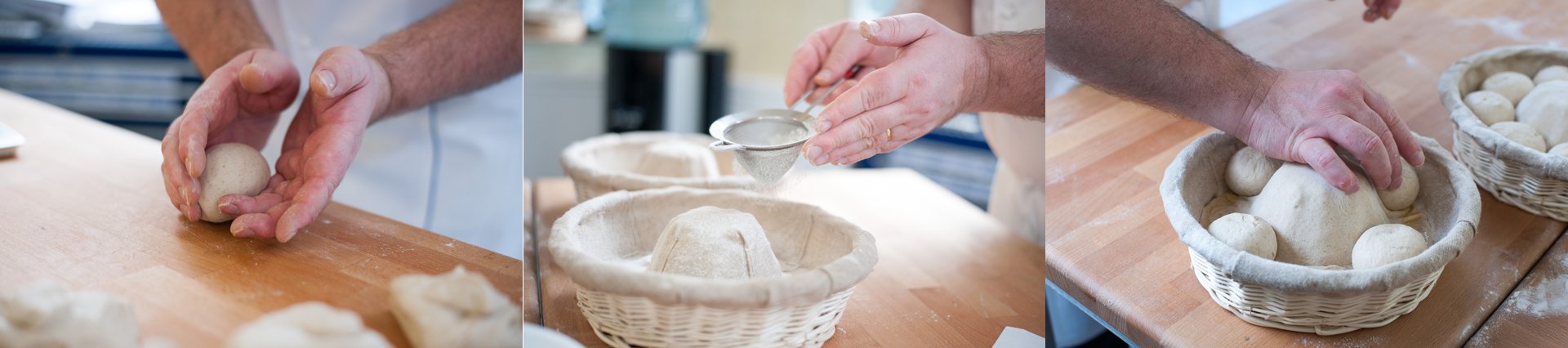
Although this constitutes the most important part of the job, a baker must also make sure that they are aware of the latest trends and their clients’ needs in order to constantly innovate. The job of boulangerie chef tends therefore to evolve in line with market needs and the modernization of equipment and techniques.
Being a Boulangerie Chef goes beyond preparing baked goods, it is a key role that involves management, responsibility, and a strong commercial dimension. The head baker must ensure the supply of raw materials, manage inventory, and oversee production according to customer demand.
Their role as a manager is not limited to leading a team; they must also anticipate orders, organise production, and adapt the product offering based on market trends. Quality and profitability management are essential, as is the optimisation of human resources.
Boulangerie Chef must have strong communication skills to supervise, motivate, and train their team while ensuring compliance with safety and hygiene standards. Leadership abilities, recruitment skills, work organisation, and production flow management are all crucial to ensuring the smooth operation of the business and customer satisfaction.
The role of a Boulangerie Chef is undoubtedly one of the most demanding in the food industry, as reflected in the working conditions: irregular hours, night shifts, long hours on foot, and a hot, humid environment. These physical aspects are an inherent reality of the profession, which can be practised in a wide range of settings, including independent bakeries, chains, pâtisseries, supermarkets, restaurants, hotels, and even production companies.
Working hours can start very early, depending on the establishment, but once the job is done, the satisfaction of customers and the quality of the finished products make the experience highly rewarding. In terms of salary, earnings vary based on experience and the type of business. A beginner boulangerie chef can expect to start at around €1,500 gross per month, while experienced professionals—particularly in prestigious establishments in Paris—can earn between €3,000 and €3,300 per month, or even more, with salaries sometimes reaching €4,000 gross per month.
Additionally, many permanent job opportunities (CDI) are available for professionals with expertise in the field, offering career progression prospects. A solid understanding of hygiene and safety standards is, of course, essential, as is a strong focus on customer satisfaction—an important factor in ensuring long-term success and sustainability for any establishment.


The job of bakers is often devalued, working conditions are hard in a bakery, and weekends and bank holidays are frequently working days. A baker can work both night and day. On the other hand, as was stated earlier, the modernisation of equipment has allowed working hours to be reduced and the baker’s workload to be lightened, which makes the occupation more and more attractive to the new generations.
Do you want to become a baker? First of all, you will have to get the appropriate education! A Boulangerie Diploma, lasting 3 months, is available at Le Cordon Bleu Paris. To register, you must be at least 18 years of age at the beginning of the programme and have a baccalaureate or equivalent. Those having followed the boulangerie training programme and obtained the related certification can go on to work in a traditional bakery or production company. They can, for example, work as a baker and, once they have gained enough experience, open their own bakery or become a team leader or production manager. In France, a novice bakery worker’s gross income is approximately 1500 € per month and the wage can increase if nights, Sundays and public holidays are worked. The monthly income for an artisan baker who owns their own business is estimated to be between 3500 € and 4000 €.
In 2016, I decided to retrain to enable me to move into a sector about which I am passionate: boulangerie. In order to be able to master the techniques for making traditional French bread and freshly baked pastries, it was essential for me to learn with an Institute which specialized in this field : Le Cordon Bleu. I want to reach the very highest levels of excellence in my aim to become a baker, and the quality of Le Cordon Bleu programmes is renowned around the world. The training and the instructors are recognized in their field, the infrastructure, the working conditions, the equipment, and the training programme, are better than those you find when preparing for a CAP boulangerie.
Copyright © 2026 Le Cordon Bleu International B.V. All Rights Reserved.
