
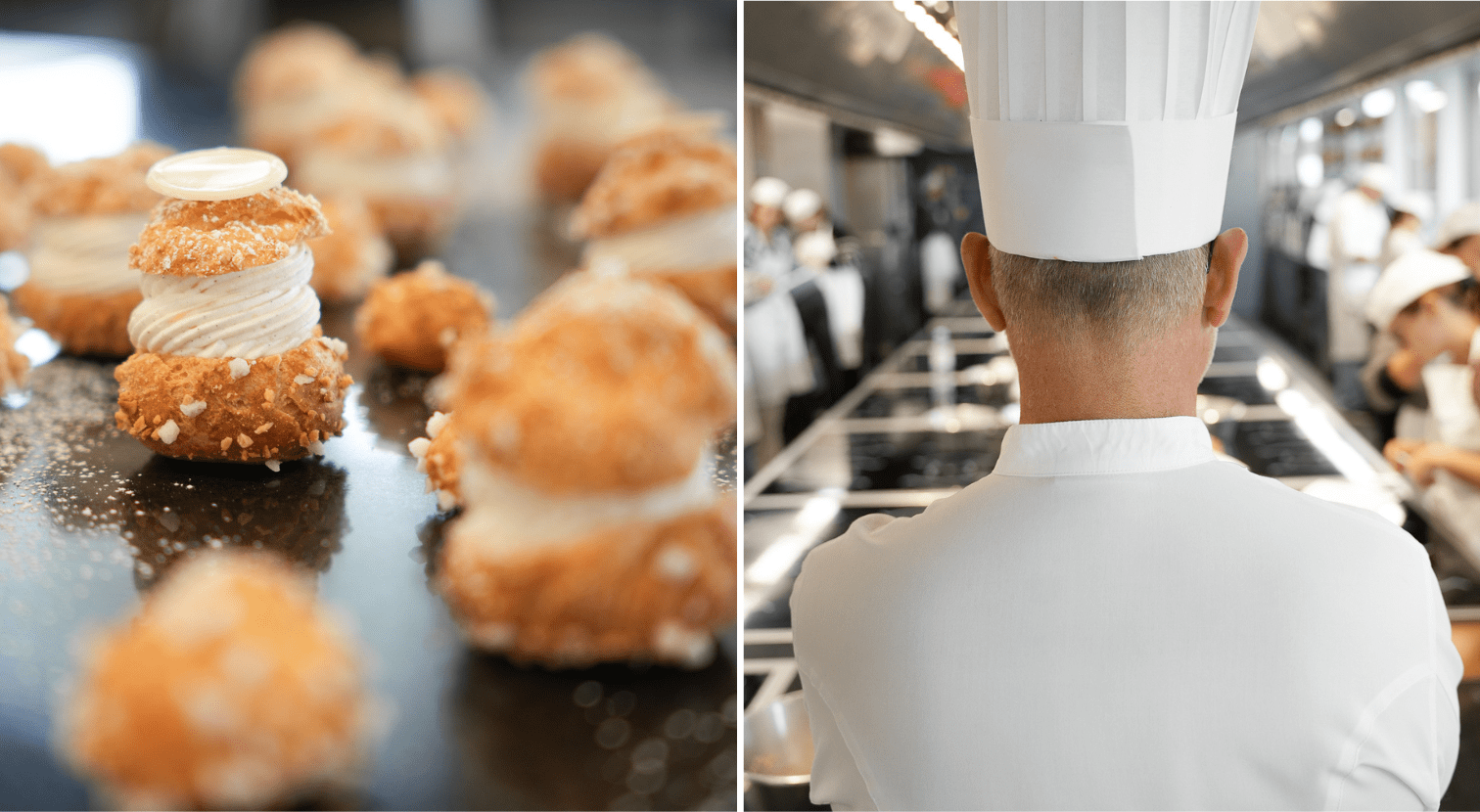
Are you passionate about sweet things, love the smell of melted chocolate, or fascinated by the precision of a pastry chef?
Becoming a pastry assistant could be the ideal springboard to a career in the world of French patisserie. Whether in a bakery, shop, ice cream parlour, chocolate shop, caterer or laboratory, this job gives you a behind-the-scenes look at a world where cakes, choux pastries, macarons, freshly baked pastries, biscuits, chocolates and other sweet treats are created.
Whether you are changing careers or looking for your first experience, this profession will introduce you to the day-to-day preparations of pastry chefs, confectioners and cooks, in an environment where precision meets creativity to delight food lovers.
A pastry assistant is a discreet but essential part of any pastry brigade. Reporting to the chef or head pastry chef, they ensure production runs smoothly by providing day-to-day logistical support. They do not create their own recipes but play a role in production by carrying out preparatory tasks precisely and quickly.
This job is clearly distinct from that of an experienced pastry chef, who designs products, manages orders and supervises a team. A pastry assistant observes, learns and carries out simple techniques in strict compliance with instructions. It is a position in which you are constantly learning and develop concrete skills on the job.To thrive as a pastry assistant, certain qualities make all the difference:
A typical day as a pastry assistant involves 5 key stages:
You do not need a diploma for this job but training can make all the difference in accelerating your career.
Recommended training programmes:
Being a pastry assistant means working an intense world, where passion goes hand in hand with high standards.
5 major constraints to daily life: Early morning fatigue, fast pace, ensuring the cold chain is not broken, strict hygiene and constant precision.
At the start of their career, a pastry assistant in France generally earns around the minimum wage, i.e. between €1,400 and €1,500 net per month. The salary varies according to the type of establishment (artisanal, large retailer, restaurant) and status (apprentice, intern, employee).
With experience, specialisation, or advancement to a higher position, remuneration can rise rapidly. Some establishments also offer hourly bonuses (for night or Sunday work), or benefits in kind (meals, discounts on products, etc.).
Apprenticeship pay is calculated as a percentage of the minimum wage but increases with age and years of study.The position of pastry assistant is not an end, but rather the start of a career path:
It is not uncommon to confuse the jobs of pastry assistant and pastry commis, but their roles and objectives are different. A diploma is not necessary to work as a pastry assistant as it mainly involves supporting the teams by carrying out simple tasks such as cleaning equipment, preparing products or keeping the laboratory clean and tidy. It is a job which involves observation and learning, ideal for discovering the profession on the job.
A pastry commis, on the other hand, is often working towards obtaining a diploma, such as a CAP or a Bac Pro. They are responsible for more technical tasks, such as preparing dough, making small entremets, presenting desserts, etc. This job requires a certain mastery of basic techniques and logically progresses towards more qualified positions.
If you are completely new to the profession or want to try out the world of patisserie before embarking on a training programme, the position of pastry assistant will suit you perfectly. On the other hand, if you are already on a training programme or are looking to rapidly improve your skills, the position of pastry commis offers more technical responsibilities and a structured framework in which to progress. Choosing between the two depends above all on your profile, experience and career ambitions.
Copyright © 2026 Le Cordon Bleu International B.V. All Rights Reserved.