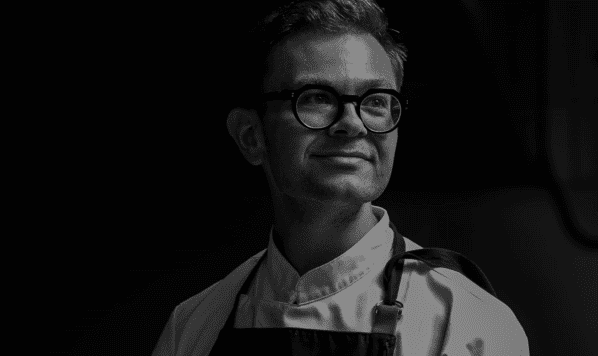
Vegetarian for over ten years, Mehdi Labed has turned plant-based cuisine into a true language of creativity, meaning and emotion. Trained in our Plant-Based Culinary Arts Diploma at Le Cordon Bleu Paris in 2023, he is now pursuing a path shaped by high standards, curiosity and a deeply contemporary vision of the plant-based world. Combining the transmission of techniques, fermentation and a sensitive approach to living things, he represents a new generation of chefs who are reimagining plant-based gastronomy with both talent and conviction.
1) You have been vegetarian for over ten years, and you also grew up in a family deeply connected to hospitality through your family restaurant. At what point did you realise that plant-based cooking could become a professional path?
I think that idea gradually developed over time. I knew that if I was going to move into cooking, a career change had to be fully aligned with my values, especially respect for animals and the planet. I see gastronomy as a whole ecosystem, where every living being has its place and deserves respect.
Some of my early inspirations were places such as Farmacy in London, Planta in Toronto, Saint-Jean in Amsterdam and Hangawi in New York. These were iconic establishments that marked a real turning point in plant-based cuisine, offering something so innovative that even the most sceptical people were curious to discover it. As I watched those models grow and my own vision became clearer, I gradually began to imagine a genuine professional future built around plant-based cooking.
2) What made you want to take the Plant-Based Culinary Arts Diploma at Le Cordon Bleu Paris, and what were you hoping to find when you started the programme?
I would say the first thing that drew me in was the fact that a school like Le Cordon Bleu Paris was offering such an innovative programme, one that feels in tune with the way gastronomy is evolving today and clearly stands apart from the more traditional approach taken by many French culinary schools.
I have always been drawn to progress, and to people who dare to innovate. Le Cordon Bleu Paris is an institution that strives for excellence and has trained some of the finest chefs around the world. I wanted to discover what this programme had to offer, and how the fundamental techniques of French cuisine could be reimagined through a plant-based approach that uses no animal products at all.
To me, the programme complemented the skills I had already developed and gave me the opportunity to focus fully on plant-based cooking and to understand how to elevate fruit, vegetables and grains. I was also very happy to be introduced to plant-based pastry, which at that time was still relatively unknown and undervalued, but which now speaks to a much wider audience, whether for ethical reasons, allergies or different dietary needs.
3) In what way did studying the Plant-Based Culinary Arts Diploma at Le Cordon Bleu Paris shape your approach to plant-based cuisine? Which foundations, techniques or practices from the programme still stay with you today?
I think my experience at Le Cordon Bleu Paris gave me all the foundations I needed to approach cooking from both a professional and gastronomic perspective. You start with the basics: Different cutting techniques, how to hold a knife, correct seasoning, making a sauce, preserving ingredients and creating balance.
What left the strongest impression on me, however, was the importance placed on cleanliness and on the organisation of our workstation. The Chefs are uncompromising and, with hindsight, I think that is probably one of the most important things in a professional kitchen. The way you organise mise en place (prepping) can genuinely determine the quality of service. All of these lessons are deeply rooted in my memory and continue to guide me every day in my career.
4) After Le Cordon Bleu Paris, you began working at De Nieuwe Winkel, a two-MICHELIN-starred plant-based restaurant known for its particularly demanding and innovative approach. What did you gain from that experience, and how did it enrich your own perspective on plant-based cooking?
My time at De Nieuwe Winkel was one of the most enriching culinary experiences I have had. I was introduced to a wide range of new flavours, techniques and ingredients. I already knew the potential of plant-based cuisine, but that environment opened an entirely new dimension for me, one that was deeper and more inspiring. Research and food science play a central role in the restaurant, which enables constant innovation. I was lucky enough to spend time in the fermentation laboratory, where I became familiar with the production of shoyu, miso and tempeh. In short, these processes make it possible to build depth, umami and complexity from relatively simple ingredients. These qualities are historically associated with meat, so discovering how they could be developed in a fully plant-based kitchen was a real revelation.
I believe this kind of experience is an invaluable source of inspiration for anyone training as a chef. Personally, I think it is essential to explore different types of cuisine and absorb what speaks to you most, in order to build your own identity. Finding your own culinary style is a real journey, and I believe it is one that lasts a lifetime. De Nieuwe Winkel is definitely one of the key inspirations that continues to shape my work on a daily basis.
I was also very fortunate to be part of a kind and supportive team, where transmission and respect were considered core values. It showed me that it is possible to pursue excellence while still treating the people around you with respect.
5) Today, you are particularly interested in research, fermentation and the new possibilities offered by plant-based ingredients. What drives you in this approach, and how does it shape your vision of the cuisine of tomorrow?
I want to push the potential of my creativity as far as possible. I hope to offer a new kind of culinary experience, both for people who are already convinced by plant-based cuisine and for those who may still be sceptical. I also see gastronomy as something that can enter into a dialogue with other forms of art, because I am convinced that everything is interconnected. Through my cooking, I want to express my own sensibility and communicate the inspirations that come to me from architecture, nature, music, literature, cinema and fashion. To me, this is about far more than “just food”. I see it as part of a much wider conversation. I am often inspired by colours, shapes, textures and ecosystems. I love the idea that, for a few hours, guests can take a break, leave the past behind, leave the future aside, and focus only on what matters in that moment: The present. Of course, that kind of experience requires a great deal of research and a lot of unseen work behind the scenes. It has also taught me patience.
That said, my greatest motivation will always be respect for living things. My goal is to create new approaches that do not harm others or the planet. Food lies at the heart of environmental issues, and I believe our role as chefs will be to find a balance between pleasure and individual responsibility. The more innovative and high-quality alternatives we can offer, the more open society will be to a new model.
6) In your opinion, what future lies ahead for plant-based cuisine? And what would you say to those who are thinking about taking a Plant-Based Gastronomy Diploma at Le Cordon Bleu Paris today?
It is difficult to answer that question with certainty, as society is changing so quickly. There are constantly new innovations and new ideas about what the cuisine of tomorrow will look like. For me, it is essential to stay true to your values and not simply follow every culinary trend.
Objectively, I believe plant-based cuisine has a very bright future ahead of it. It has already proved itself over many years, and we can all agree that it is not just a passing trend. Its strengths and what it has to offer are undeniable. It is a cuisine that constantly questions itself and still has so much more to develop and reveal. To be honest, I believe we have only seen the very beginning of its potential.
There is still a great deal of work to be done to make it more widely accessible, especially in more rural areas. I also believe that everyone who begins this programme can, in one way or another, contribute to that change.
I would also say that my time at Le Cordon Bleu Paris was among the happiest periods of my life, and I would encourage future students to make the most of it: experiment, share and engage with the people around them. As an international school, Le Cordon Bleu Paris gives us the opportunity to meet people from all over the world and to discover different cultures. That is incredibly important, both on a personal level and from a culinary point of view.
Finally, in this profession, it is essential to accept failure and allow yourself to learn from it. It is a driver of progress and creativity, and a valuable source of learning and growth.
Copyright © 2026 Le Cordon Bleu International B.V. All Rights Reserved.